In many ways, baseball is an extremely complex game. In others, it's very simple: one man tries to throw a ball past a man holding a bat. To go a little further: the first man stands on a mound, while the second stands in a box. That's just the way it is, and always has been. Nobody much questions the existence of the mound and the box.
According to Kevin Kouzmanoff, however, this seemingly inconsequential mandate is anything but.
"I get claustrophobic in there, man", says Kouzmanoff. "Society pigeonholes us into these little boxes. You have to go to school, and then university, and then you're going to be a doctor, and you're going to be a carpenter, and you're going to be a copy editor, and then you get married, you have kids, and then you die. It's just one huge box made up of tiny component boxes, and there's no breaking out of it."
But Kouzmanoff says this existential anxiety he feels isn't the only kind of claustrophobia present when he steps into the box.
"Oh yeah, it's physical too. Those lines… I can't deal with those lines. I feel them pressing on me, pushing me up, pulling me down, squeezing me like a straitjacket, from every direction. The only way I can handle it is with the knowledge that, if I hit the ball, I tear a hole in the fabric of that box, allowing me to break through and escape."
Despite Kouzmanoff's discomfort, he says that once he's in the batter's box, he never steps out, even between pitches. "How could I?" he exclaims. "It's solid. There are no exits. It's made of diamond, or carbon nanotubes, or something equally impenetrable. It would be physically impossible for me to leave that box before I succeed in my quest to rip it open."
Removed from the action, Kouzmanoff seems completely self-aware of his condition. But as he describes it more and more, it becomes clear that he can't fully accept the illogic of his inability to leave the batter's box. He seems to truly believe that, once he steps in, some sort of tangible, transparent, extremely durable box descends and envelops him. It isn't rational; how, for example, can his hands and bat extend out of the box when he swings? How does he walk back to the dugout when he strikes out? But then, psychological illness is complicated and doesn't always make sense.
Kouzmanoff recognizes that his struggle to overcome his fear is an ongoing process, and has been attending therapy for several years. His therapist has tried novel strategies, such as building a mock batter's box in his office.
"I believe that recreating the circumstances of the difficulties is paramount to vanquishing them." That's Dr. Robert Placzek, who specializes in batter's box-related phobias. When asked whether this strategy has worked, Placzek's face falls a little. "Unfortunately not. Thus far, each time Kevin gets in the box, he hasn't been able to leave until he hits a baseball. I've lost a lot of windows, and my entire collection of autographed framed photos from the 1929 Yankees. I'm not sure why I kept hanging them on the wall."
But Placzek is resolute. "We've made progress", he says. "Kevin no longer needs the ball to be fair in order to break out of the box. Foul balls work too. (It isn't clear how Kouzmanoff and Placzek determine what's fair and what's foul in a therapist's office.) Unfortunately, this breakthrough hasn't yet translated to real games, but it's something. Baby steps are always the mode d'emploi in this field."
Of course, phobias often develop as a result of childhood trauma. Kouzmanoff is reluctant to talk about what first instilled this deep-seated claustrophobia, but his doctor believes that unwrapping the mystery is the key to understanding Kouzmanoff's condition.
"I can't force him to talk about it; it just doesn't work. A few times, I've managed to get him into a relaxed, wistful state, where he just lets the words babble out without thinking about what he's saying. From what I understand, there was an incident one Halloween. I don't really understand this part, but it seems that one year, Kevin dressed up as a batter's box. I believe something terrible happened inside that box, but I haven't got that far. As soon as he realizes what he's saying, he wakes from his trance and is absolutely furious. He's smashed up my office so many times, I really have no idea why I keep suspending priceless crystal ducks from the ceiling at piñata height."
But no matter the cost, Placzek says it'll all be worth it in the end. He's a man utterly dedicated to his profession, and the knowledge that he helped a single person overcome their fears is worth more than any number of priceless crystal ducks.
Saturday, November 13, 2010


Wednesday, November 10, 2010
Why Change-ups > Sliders
There are many ways by which pitchers can attempt to fool batters in the great game of baseball. They can throw the ball fast, throw it slow, spin it down, spin it across, make it rise, make it zigzag, throw two (or more) balls at once, bank it off the ceiling, make it boomerang, shoot it out of a cannon.... the list goes on and on.
Two of the most prevalent techniques in a pitcher's arsenal are the slider and the change-up. I'm here to tell you why the change-up is always, in every case, definitively better than the slider.
1. Sliders Are Gross
As you well know, the slider is named after the miniature hamburger popularized by American chain White Castle. According to this nutritional information, an "A1 Slider", the namesake of the pitch, contains 9% of a person's recommended daily fat intake, and 18% of their daily sodium. Now, that may not seem like much, but remember - these are miniature hamburgers we're talking about. An average White Castle meal contains four of those bad boys. We're talking more than a third of your daily fat, and almost three-quarters of your daily sodium! And that doesn't even include the fries and coke!
Sliders embody everything wrong with America: unhealthy processed food, deception-based marketing, sharp left turns (did I just analogize the motion of a baseball pitch to the political climate of the most powerful country on Earth? You better believe I did). And with slider usage on the rise in baseball, it's no surprise our kids are getting fatter and fatter.
 |
| 6 grams of fat per pitch |
2. Change-ups Are Classier
Did you know that broadcasters used to call the change-up the "change of pace"? Isn't that awesome? Doesn't it just remind you of those crazy old-school pitching mechanics? The slider doesn't have any cool old-school nicknames. In fact, according to Wikipedia, one of its nicknames is the "yakker", which really only adds to the Gross Hypothesis.
Plus, whoever came up with the change-up was a genius. I can imagine the first time someone figured out there were pitches other than fastballs. "Hey, I keep throwing it as hard as I can, and they keep hitting it really hard. What should I do?" "Uh, throw it faster?" "Dude, I told you, I'm throwing as fast as I can!" "Um, okay, why don't you try throwing it, uh, slower?" "Slower? What? That's stupid. They'll just hit it harder!" "Man, I dunno. Just try it!"
(In case you're wondering, 19th century baseball players did in fact call each other 'dude' and 'man'.)
3. Sliders Are Gross
I want you to take a moment, close your eyes, and imagine a pitcher throwing a slider. Visualize every detail - the batter, the teams, the weather, the score, how well-attended the game is, who's umpiring, what merchandise is for sale, what else is going on the city that day. Everything.
Got it?
Now watch that game in your head for at least seven minutes.
...
The pitcher had a gross '80s moustache, right?
4. 'Pulling the String'
There are a lot of stupid baseball clichés out there, and while players, managers and fans have been known to spout these meaningless banalities from time to time, nobody is more distinguished in the cliché arts than the broadcaster.
However, sometimes a cliché enters the lexicon simply because it's great, and though it gets overused and sometimes misused, it doesn't diminish that greatness. I love when broadcasters say "Santana really pulled the string on that one", because it's a very satisfying descriptive phrase. Watching a batter flail wildly at a pitch that's still ten feet from reaching him makes one believe that the pitcher really does have a string that he can yank at any moment to make the hitter look foolish, and that's a beautiful metaphor, at least in my mind.
5. Sliders Are Gross
"Slider? I hardly even know her!"
How many times have you heard this disgusting, horrific, misogynistic phrase uttered by players, coaches, announcers? I'll tell you how many times: too many times. Stop the sexism. Abort sliders.
---
If there was any doubt in your mind before, obviously that's been erased. The change-up is superior to the slider in every way, and it's not particularly close. Why any pitcher would continue to use the slider is beyond me. But then, I'm a vegetarian.
Monday, November 8, 2010
Adam Dunn Admits to Liking Baseball
Contrary to a 2008 quote from then-Blue Jays GM J.P. Ricciardi, Adam Dunn does, in fact, like baseball. He clarified his position on Sunday, more than two years after the initial accusation. "After giving it a lot of consideration, I have decided to respond to Mr. Ricciardi's claim. Following the completion of an in-depth cost-benefit analysis, it has become clear to me that I do, in fact, like baseball."
Ricciardi's initial charge went as follows: "Do you know that [Dunn] doesn't really like baseball that much?" He went on, stating that Dunn "is not enamoured with", "fails to maintain interest in" and "is indifferent at best" to the sport. Dunn, an extremely thoughtful and meticulous individual, did not respond as most would to such an egregious claim (by bluntly tossing insults back through the media), but instead retreated into solitary contemplation. Two and a half years of careful analysis produced the following chart:
In fact, Dunn says his hibernative refuge stemmed from an earlier phase in his career in which he genuinely convinced himself that he didn't like baseball. "My college buddies all hated their jobs," the slugger said, "and I always felt awkward hanging out with them, because all they wanted to do was complain about the technical report they had due on Friday, or the trade show they had to go to in Albuquerque, or the synergy analysis they had to get synergized. So I started telling them about the shitty parts of being a major league baseball player. Eventually, they started to believe it. And I think I did too."
They really sympathized with me," Dunn responds when asked about his friends' reaction to this new perspective on America's pastime. "I don't think they ever realized how truly gruelling and frustrating it is to be constantly on the road, never getting a day off, never seeing your family and always in fear that you'll get traded and suddenly see your family even less. But once I explained all that to them, they took me in and nurtured me like a wounded dove."
However, it seems that Dunn's friends weren't being completely honest with him. Andrew Percy, a former fraternity roommate, says that they saw through the ruse from the beginning. "That was such BS, man", says Percy. "I mean, c'mon. He makes millions of dollars because he's really good at PLAYING A GAME that is honestly oh my god so much fun to play. Is he fucking serious? Any of us would trade our lives for his in a second."
When pressed about why he never relayed this information to Dunn, Percy says that the group was worried about Adam's fragility. "Adam is a gentle flower. The slightest gust of wind can sweep him off course, and he might never find his way back home."
Fortunately, thanks to his time away from civilization, that may no longer be true. Dunn took all that confusion and turmoil in his mind and slowly but surely kneaded it until all the knots were straightened out. He emerged from that Pacific Northwest forest a new man. One who knows who he is. One who listens to Fleet Foxes, brews his own beer, and rocks a sweet beard. And one who genuinely likes baseball.
Ricciardi's initial charge went as follows: "Do you know that [Dunn] doesn't really like baseball that much?" He went on, stating that Dunn "is not enamoured with", "fails to maintain interest in" and "is indifferent at best" to the sport. Dunn, an extremely thoughtful and meticulous individual, did not respond as most would to such an egregious claim (by bluntly tossing insults back through the media), but instead retreated into solitary contemplation. Two and a half years of careful analysis produced the following chart:
 |
| Dunn's two-year brainstorm resulted in this pro-con chart |
They really sympathized with me," Dunn responds when asked about his friends' reaction to this new perspective on America's pastime. "I don't think they ever realized how truly gruelling and frustrating it is to be constantly on the road, never getting a day off, never seeing your family and always in fear that you'll get traded and suddenly see your family even less. But once I explained all that to them, they took me in and nurtured me like a wounded dove."
However, it seems that Dunn's friends weren't being completely honest with him. Andrew Percy, a former fraternity roommate, says that they saw through the ruse from the beginning. "That was such BS, man", says Percy. "I mean, c'mon. He makes millions of dollars because he's really good at PLAYING A GAME that is honestly oh my god so much fun to play. Is he fucking serious? Any of us would trade our lives for his in a second."
When pressed about why he never relayed this information to Dunn, Percy says that the group was worried about Adam's fragility. "Adam is a gentle flower. The slightest gust of wind can sweep him off course, and he might never find his way back home."
Fortunately, thanks to his time away from civilization, that may no longer be true. Dunn took all that confusion and turmoil in his mind and slowly but surely kneaded it until all the knots were straightened out. He emerged from that Pacific Northwest forest a new man. One who knows who he is. One who listens to Fleet Foxes, brews his own beer, and rocks a sweet beard. And one who genuinely likes baseball.
Saturday, October 16, 2010
Could Philadelphia Win Game 1 With 0 Runs?
In their respective National League Division Series, Roy Halladay and Tim Lincecum each pitched the first playoff game of their career. Halladay, as you probably know, threw a no-hitter, the second in playoff history. The next day, Lincecum hurled a two-hit shutout while striking out 14 Atlanta Braves. His game score, a statistic designed as a fun way to compare individual games thrown by starting pitchers, was 96, and was actually slightly higher than Halladay's (95). Most years, a game score that high would rank somewhere in the top three games pitched all season, and it happened twice within two days in these 2010 playoffs.
Halladay and Lincecum are scheduled to face each other in game one of the National League Championship Series on Saturday, and ever since that match-up became a reality, fans have been salivating in anticipation. What might happen? Simultaneous no-hitters? 54 strikeouts combined? Will any hitter even make contact? The hyperbole has gotten out of hand.
(Note: the aforementioned out-of-hand hyperbole refers exclusively to that put forth on this blog.)
But here at Bottom of the Fourth, we think the hyperbole is completely justified - that's how good Halladay and Lincecum are. In fact, we believe it isn't yet out-of-hand enough.
So the question must be asked: could the Phillies get shut out and still win this game?
It seems like an impossible task, one that's never been done before. But just because something has never been done doesn't mean it will never happen. Neil Armstrong never said "well, nobody's ever walked on the moon, it must be impossible." No. He went out and walked on the fucking moon. Did the Wright brothers ever think "hey, maybe we shouldn't spend all this time building something that nobody's ever built before"? Of course not. They kept building and flew a fucking plane. And just because no-one had ever filmed a recorder version of My Heart Will Go On by candlelight, that didn't fucking stop Matt Mulholland.
So yeah, I believe the answer to the question is yes, the Phillies could get shut out and still win this game. Now, you may be wondering: why the Phillies and not the Giants? And it's a fair question - it certainly could happen both ways. I just think the Phillies superior offense will enable them to score fewer negative runs.
Which leads us to another question: negative runs? How does that work?
It's actually a little-known rule that has been in the book for many years. It hasn't been applied in recent memory because, well, who actually reads all the rules? That tome is thicker than Ken Griffey Jr.'s head in the Simpsons. Major league umpires simply aren't aware of the rule, so it never gets applied.
That doesn't explain how it works, though, so here is a short primer. Whenever a pitcher induces a batter to strike out in a manner so foolish that an umpire judges it to have been at least "ridiculous", and up to and including "absurd", the batter receives a Reverse Walk. He is sent to third base and is to advance backwards on the base-paths. He doesn't run on balls in play (at least he isn't required to, but he may if he wants, at great disadvantage to his team); he only advances whenever another Reverse Walk is issued, in which case the batter does not go to third base; only the current runner moves up. (i.e. there is only one Reverse Runner on the bases at any one time.)
When a Reverse Runner reaches home plate, his team scores a negative run. This run is taken away from the team's current score, and if that score is already zero, it dips below. Now, the best case scenario for a pitcher in one inning is to induce three strikeouts* greater than or equal to "ridiculous". In this case, the Reverse Runner first goes to third, then second, then first, and cannot reach home plate. However, unlike regular base-runners, Reverse Runners are carried over to the next inning, so a team would be gradually accumulating negative runs throughout the game, if the rule were applied properly.
*Note: like regular strikeouts, it is in fact possible to accumulate four Reverse Walks, and therefore a negative run, in the same inning; it simply requires one of the "ridiculous" strikeout victims to reach first base on a dropped ball by the catcher. This results in the unlikely scenario of runners going to first and third on the same strikeout. A pinch runner is used as the Reverse Runner.
Teams would of course need to be aware of which runners are which. Regular rules don't allow two runners to be at the same base, but that scenario is sometimes unavoidable when Reverse Runners come into play. A team may have two runners at the same base, as long as they're traveling in different directions, but need to be extra cognizant of the situation to ensure that no runner travels in the wrong direction, resulting in the runner being called automatically out. Runners may also not make contact, including anything from incidental base-running-related contact to high-fiving and other celebratory gestures. This temptation can be difficult to avoid in a case such as a walk-off home run because of the finality of the play; however, in this case, a flagrant high-five or pat on the butt by the Reverse Runner results in a reversal of the home run and a penalty out, possibly enough to turn a win immediately into a loss through a simple union of palms.
Both teams in the NLCS have their fair share of Ridiculous Strikers Out (RSOs). Pat Burrell (145), Aaron Rowand (129) and Andres Torres (128) of the Giants were each in the top 10 in the NL in RSO+, a statistic designed to compare the rate of Ridiculous Strikeouts (average is 100). But Philadelphia has a secret weapon. Ryan Howard, while merely very bad as measured by RSO+ (135), is the most prolific Preposterous Striker Out in the history of the game.
Preposterous Strikeouts (PSOs) are a notch above Ridiculous on the Ridiculous-Absurd scale, and statisticians have found that PSOs are much more predictive of future ridiculosity than RSOs. Ryan Howard has led the majors in PSOs each of the last five years, and even holds the major league record for PSOs in a season (63 in 2008) So despite San Francisco's incredibly Ridiculous 2010 outfield, if there's one player who will make a (negative) difference with his bat in this series, it's Howard.
Halladay and Lincecum are scheduled to face each other in game one of the National League Championship Series on Saturday, and ever since that match-up became a reality, fans have been salivating in anticipation. What might happen? Simultaneous no-hitters? 54 strikeouts combined? Will any hitter even make contact? The hyperbole has gotten out of hand.
(Note: the aforementioned out-of-hand hyperbole refers exclusively to that put forth on this blog.)
But here at Bottom of the Fourth, we think the hyperbole is completely justified - that's how good Halladay and Lincecum are. In fact, we believe it isn't yet out-of-hand enough.
So the question must be asked: could the Phillies get shut out and still win this game?
It seems like an impossible task, one that's never been done before. But just because something has never been done doesn't mean it will never happen. Neil Armstrong never said "well, nobody's ever walked on the moon, it must be impossible." No. He went out and walked on the fucking moon. Did the Wright brothers ever think "hey, maybe we shouldn't spend all this time building something that nobody's ever built before"? Of course not. They kept building and flew a fucking plane. And just because no-one had ever filmed a recorder version of My Heart Will Go On by candlelight, that didn't fucking stop Matt Mulholland.
So yeah, I believe the answer to the question is yes, the Phillies could get shut out and still win this game. Now, you may be wondering: why the Phillies and not the Giants? And it's a fair question - it certainly could happen both ways. I just think the Phillies superior offense will enable them to score fewer negative runs.
Which leads us to another question: negative runs? How does that work?
It's actually a little-known rule that has been in the book for many years. It hasn't been applied in recent memory because, well, who actually reads all the rules? That tome is thicker than Ken Griffey Jr.'s head in the Simpsons. Major league umpires simply aren't aware of the rule, so it never gets applied.

That doesn't explain how it works, though, so here is a short primer. Whenever a pitcher induces a batter to strike out in a manner so foolish that an umpire judges it to have been at least "ridiculous", and up to and including "absurd", the batter receives a Reverse Walk. He is sent to third base and is to advance backwards on the base-paths. He doesn't run on balls in play (at least he isn't required to, but he may if he wants, at great disadvantage to his team); he only advances whenever another Reverse Walk is issued, in which case the batter does not go to third base; only the current runner moves up. (i.e. there is only one Reverse Runner on the bases at any one time.)
 |
| An example of a strikeout that is at least "ridiculous" |
When a Reverse Runner reaches home plate, his team scores a negative run. This run is taken away from the team's current score, and if that score is already zero, it dips below. Now, the best case scenario for a pitcher in one inning is to induce three strikeouts* greater than or equal to "ridiculous". In this case, the Reverse Runner first goes to third, then second, then first, and cannot reach home plate. However, unlike regular base-runners, Reverse Runners are carried over to the next inning, so a team would be gradually accumulating negative runs throughout the game, if the rule were applied properly.
*Note: like regular strikeouts, it is in fact possible to accumulate four Reverse Walks, and therefore a negative run, in the same inning; it simply requires one of the "ridiculous" strikeout victims to reach first base on a dropped ball by the catcher. This results in the unlikely scenario of runners going to first and third on the same strikeout. A pinch runner is used as the Reverse Runner.
Teams would of course need to be aware of which runners are which. Regular rules don't allow two runners to be at the same base, but that scenario is sometimes unavoidable when Reverse Runners come into play. A team may have two runners at the same base, as long as they're traveling in different directions, but need to be extra cognizant of the situation to ensure that no runner travels in the wrong direction, resulting in the runner being called automatically out. Runners may also not make contact, including anything from incidental base-running-related contact to high-fiving and other celebratory gestures. This temptation can be difficult to avoid in a case such as a walk-off home run because of the finality of the play; however, in this case, a flagrant high-five or pat on the butt by the Reverse Runner results in a reversal of the home run and a penalty out, possibly enough to turn a win immediately into a loss through a simple union of palms.
Both teams in the NLCS have their fair share of Ridiculous Strikers Out (RSOs). Pat Burrell (145), Aaron Rowand (129) and Andres Torres (128) of the Giants were each in the top 10 in the NL in RSO+, a statistic designed to compare the rate of Ridiculous Strikeouts (average is 100). But Philadelphia has a secret weapon. Ryan Howard, while merely very bad as measured by RSO+ (135), is the most prolific Preposterous Striker Out in the history of the game.
Preposterous Strikeouts (PSOs) are a notch above Ridiculous on the Ridiculous-Absurd scale, and statisticians have found that PSOs are much more predictive of future ridiculosity than RSOs. Ryan Howard has led the majors in PSOs each of the last five years, and even holds the major league record for PSOs in a season (63 in 2008) So despite San Francisco's incredibly Ridiculous 2010 outfield, if there's one player who will make a (negative) difference with his bat in this series, it's Howard.
Thursday, October 14, 2010
Don't Worry, C.J.!
C.J. Wilson is nervous. Because Cliff Lee just pitched game five against Tampa Bay to put the Rangers into the second round of the playoffs, the Rangers' ace isn't ready to start the next series. So game one duties fall to Wilson. Texas has faced the Yankees in four different playoff series in their history, and never won. And Wilson has the unenviable task of facing Yankees ace and Cy Young contender CC Sabathia. It shouldn't come as a surprise that C.J. Wilson is nervous.
But he doesn't need to be. As his lone playoff start showed, his teammates will pick him up when he opens the series on Friday night at home. Don't worry, C.J.!

Josh Hamilton has been saving the Rangers' pitchers all year with his bat and his defense, and that's why he's the frontrunner for the AL MVP award. But it hasn't just been Hamilton flashing the leather...


Even with superb defense, though, a pitcher still needs some run support every now and then...


Don't worry, Ceej. It'll all work out.
But he doesn't need to be. As his lone playoff start showed, his teammates will pick him up when he opens the series on Friday night at home. Don't worry, C.J.!
Josh Hamilton has been saving the Rangers' pitchers all year with his bat and his defense, and that's why he's the frontrunner for the AL MVP award. But it hasn't just been Hamilton flashing the leather...


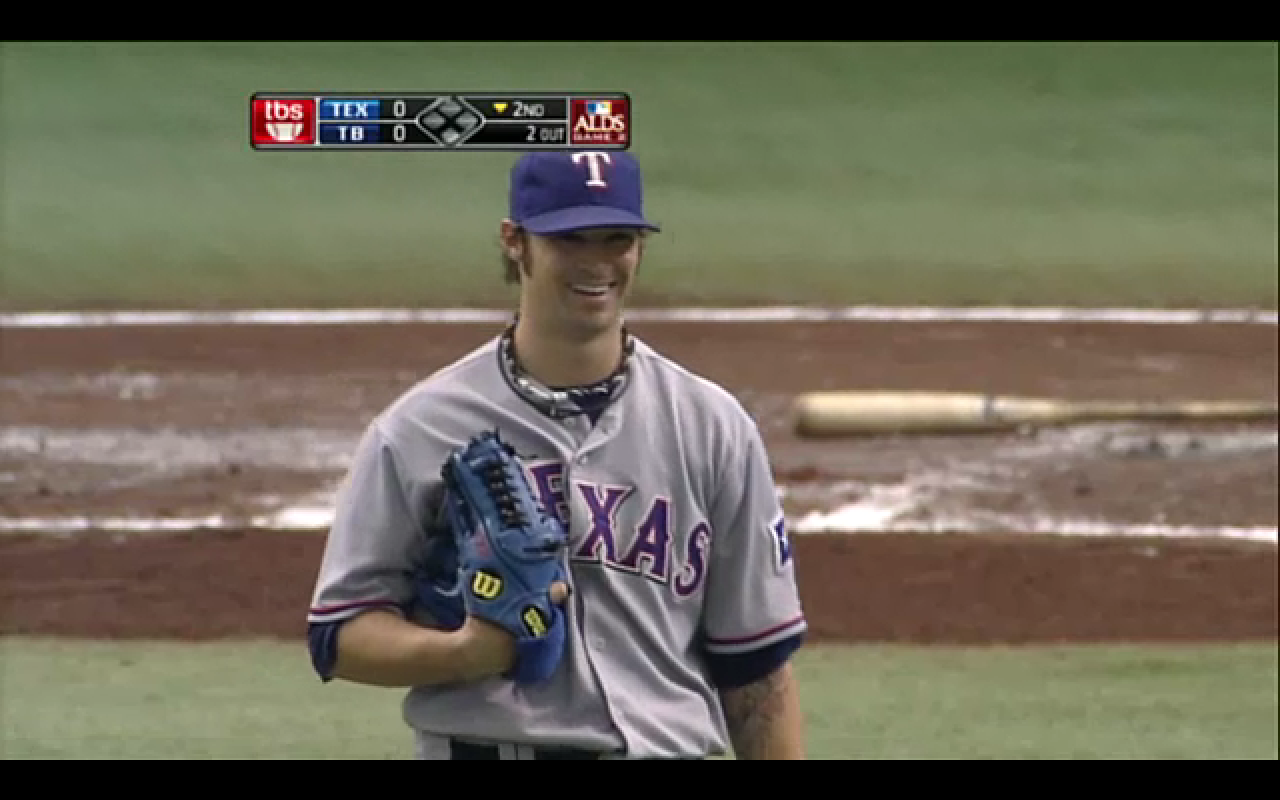
Even with superb defense, though, a pitcher still needs some run support every now and then...


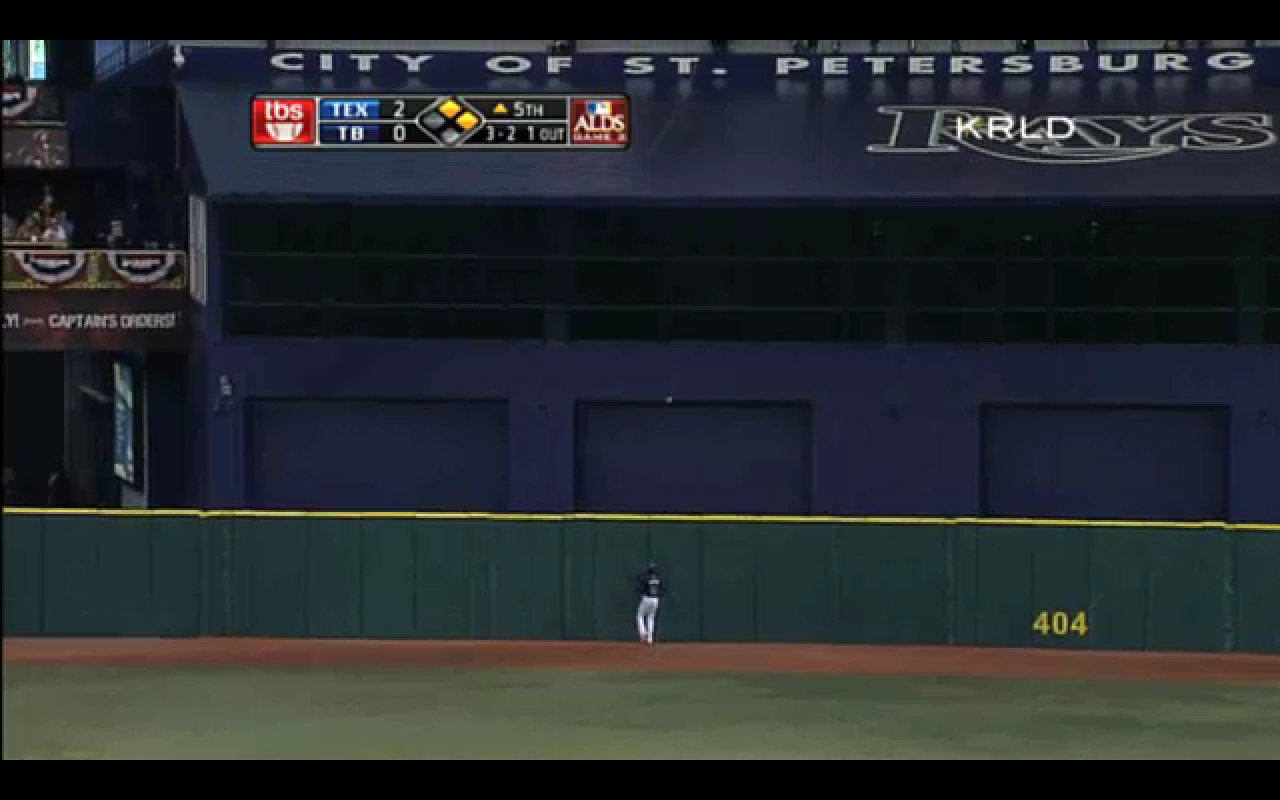

Don't worry, Ceej. It'll all work out.
Thursday, October 7, 2010
Playoff Preview: Yankees vs. Twins
This series already has one game in the books, with the Yankees winning 6-4 yesterday, but it's still worth looking at what might happen for the rest of the series.
The first question that pops into my mind when thinking about this match-up is: what kind of twins are we dealing with here? If they're identical, that could be a huge advantage for the Minnesotans. 25 pairs of identical people would provide Minnesota with all kinds of possibilities for deception. Think about running the bases: one twin could bait the Yankees into making a play at third base, only to discover he was the decoy twin, distracting the opposition while his likeness moves from first to second. An extra base might not seem like much in some cases, but over the course of a game it can really add up.
Fraternal twins, on the other hand, wouldn't provide as much of an advantage, aside from the simple fact of having double the number of players as New York, but as non-identical twins, these extra players might not even be major league caliber players. In this case, Minnesota's best strategy would probably be to pester the provoke the Yankees until things boil over and a brawl ensues, in which case Minnesota's superior numbers may be able to put several key Yankees out of commission before the umpires break things up.
Of course, the third possibility that we haven't mentioned yet is the rarest of all twins: siamese. It's not at all clear how things would go down if Minnesota was comprised of conjoined players; it could be a huge benefit, if each two-man conglomerate had the strength and speed of two men, but it's not entirely clear that that's how siamese twins work. They could also be awkward, unable to coordinate, and totally useless in a batter's box or on a pitcher's mound.
Given that one game has already been played, we can make some inferences. We didn't see any siamese twins last night, so that is unlikely to be the case. However, it didn't appear that Minnesota used any of its twins in Wednesday's game, so it's impossible to tell whether we're dealing with the identical or fraternal variety.
We know what we're getting from the Yankees. A group of dedicated, down-home Americans. They'll scratch and claw if they have to, but they don't have any special advantages. They're constant underdogs in this way, but they're already up a game in this series. But things could change quickly if Minnesota starts to make its duplicity work.
The first question that pops into my mind when thinking about this match-up is: what kind of twins are we dealing with here? If they're identical, that could be a huge advantage for the Minnesotans. 25 pairs of identical people would provide Minnesota with all kinds of possibilities for deception. Think about running the bases: one twin could bait the Yankees into making a play at third base, only to discover he was the decoy twin, distracting the opposition while his likeness moves from first to second. An extra base might not seem like much in some cases, but over the course of a game it can really add up.
Fraternal twins, on the other hand, wouldn't provide as much of an advantage, aside from the simple fact of having double the number of players as New York, but as non-identical twins, these extra players might not even be major league caliber players. In this case, Minnesota's best strategy would probably be to pester the provoke the Yankees until things boil over and a brawl ensues, in which case Minnesota's superior numbers may be able to put several key Yankees out of commission before the umpires break things up.
 |
| Two Franciscos Liriano would dramatically improve the Twins' chances |
Of course, the third possibility that we haven't mentioned yet is the rarest of all twins: siamese. It's not at all clear how things would go down if Minnesota was comprised of conjoined players; it could be a huge benefit, if each two-man conglomerate had the strength and speed of two men, but it's not entirely clear that that's how siamese twins work. They could also be awkward, unable to coordinate, and totally useless in a batter's box or on a pitcher's mound.
Given that one game has already been played, we can make some inferences. We didn't see any siamese twins last night, so that is unlikely to be the case. However, it didn't appear that Minnesota used any of its twins in Wednesday's game, so it's impossible to tell whether we're dealing with the identical or fraternal variety.
We know what we're getting from the Yankees. A group of dedicated, down-home Americans. They'll scratch and claw if they have to, but they don't have any special advantages. They're constant underdogs in this way, but they're already up a game in this series. But things could change quickly if Minnesota starts to make its duplicity work.
Wednesday, October 6, 2010
Playoff Preview: Reds vs. Phillies
It's hard to get a handle on how this match-up will go down, since it isn't entirely clear who these teams really are. The Philadelphia Phillies are named after the city in which they play; they were formerly known as the "Philadelphias", and this was later shortened to just the "Phillies". This is an odd identity for a team; if the team is composed of an entire city, what part of it faces its opponents? The people? The buildings? The city as a collective whole, looming menacingly but moving glacially?
Cincinnati is equally confusing. The Reds were originally named as such in reference to their foot-related attire (they were once known as the Cincinnati Red Stockings), but the name is ambiguous enough that it may have taken on different meanings over the years. Philadelphia goes into this series blind, not knowing whether they'll be facing a squad full of high-socked men, communists, or hyper-intelligent shades of the colour red. Or perhaps all three.
So in a world of sports in which we're accustomed to 1-on-1 duels between fierce battle-tested men and/or creatures such as Giants, Bears, Cavaliers and Sharks, this National League Division Series figures to play out more like a siege. Cincinnati will gather all the socks, commies, and hues it can muster in an attempt to lay waste to the sprawling city of Philadelphia. We know they'll have plenty of firepower: NL MVP candidate Joey Votto led the Reds to scoring 790 runs, more than any other team in the National League.
On the other side, Philadelphia will barricade the streets, reinforce its strategic centers, and put out a call to arms to every last citizen. The city is a little bruised and battered after 162 games of regular-season assault, but has held up admirably, largely thanks to the terrific three of Roy Halladay, Cole Hamels, and Roy Oswalt, who have commanded the city's defensive forces brilliantly. Much like soccer teams often do, the Phillies will retreat into their shell, relying on their superior defensive game in an attempt to expose flaws in the Reds' plans. Look for Cincinnati to tire of their full-on attack by the fourth or fifth contest, and for Philadelphia's turtle-like strategy to win out in the end.
Cincinnati is equally confusing. The Reds were originally named as such in reference to their foot-related attire (they were once known as the Cincinnati Red Stockings), but the name is ambiguous enough that it may have taken on different meanings over the years. Philadelphia goes into this series blind, not knowing whether they'll be facing a squad full of high-socked men, communists, or hyper-intelligent shades of the colour red. Or perhaps all three.
So in a world of sports in which we're accustomed to 1-on-1 duels between fierce battle-tested men and/or creatures such as Giants, Bears, Cavaliers and Sharks, this National League Division Series figures to play out more like a siege. Cincinnati will gather all the socks, commies, and hues it can muster in an attempt to lay waste to the sprawling city of Philadelphia. We know they'll have plenty of firepower: NL MVP candidate Joey Votto led the Reds to scoring 790 runs, more than any other team in the National League.
 |
| Communists, high-red-socked men, and hyper-intelligent shades of the colour red will march on Philadelphia |
On the other side, Philadelphia will barricade the streets, reinforce its strategic centers, and put out a call to arms to every last citizen. The city is a little bruised and battered after 162 games of regular-season assault, but has held up admirably, largely thanks to the terrific three of Roy Halladay, Cole Hamels, and Roy Oswalt, who have commanded the city's defensive forces brilliantly. Much like soccer teams often do, the Phillies will retreat into their shell, relying on their superior defensive game in an attempt to expose flaws in the Reds' plans. Look for Cincinnati to tire of their full-on attack by the fourth or fifth contest, and for Philadelphia's turtle-like strategy to win out in the end.
Subscribe to:
Posts (Atom)